February Newsletter
Events
We've got a big February in front of us!
02/11 – 6:00 PM – 8:00 PM
💘 SOMA Love - Cookie Swap & Valentine's Making
📍 1066 Howard
Spread the SOMA love by bringing a cookie or candy to swap and hanging out with your neighbors while we make Valentine's to spread the SOMA Love.
RSVP
02/15 - 9:00AM -10:00 AM
🧹 Neighborhood Cleanup
📍 Langton Garden
We are hosting a community cleanup event on February 15th. We'll meet at the Howard Langton Mini Garden at 9am where we will distribute supplies.
RSVP
02/19 – 6:00 - 8:00 PM
🍹 Happy Hour
📍 Bella SF
Free community happy hour!
Learn More

Government Relations Committee Update
This month, Government Relations focused on strengthening neighborhood oversight and geographic equity. We launched the SOMA West Community Monthly Working Group, facilitating collaboration between residents, city departments, and service providers to address local conditions. Our committee continues persistent public safety advocacy, urging full staffing and increased resources for the Southern Station, whose officers handle nearly double the workload of other districts while severely understaffed. Additionally, we actively advocate for strict enforcement of the One City Shelter Act, effective January 1, 2026. This legislation aims to prevent further over saturation of social services in neighborhoods like SOMA West, which already host a disproportionate share of city shelter beds.

SOMA Name Dropping: Natoma Street
By Cindy Casey
The story goes that Natoma was named after a Native American tribe that lived in the vicinity of the town of Natomas. It is considered that “Natomas” is a Maidu word meaning “north place” or “upstream people.” It has also been translated as clear water.
The Maidu resided in the central Sierra Nevada, in the watershed area of the Feather and American Rivers, and in Humbug Valley. The Maidu population in 1770 was estimated at around 9,000. Due to the discovery of gold and intrusion onto their lands, their population dropped to 330 within three decades. During the 1860s, they were forcibly marched to a reservation in Mendocino County.
Like many other California tribes, the Maidu were hunter-gatherers, primarily acorn and fishers. They tended local oak groves of Californian white, black, and tan oak trees, as well as huckleberry oak and bush chinquapin, all of which grow in the northeastern mountain region.
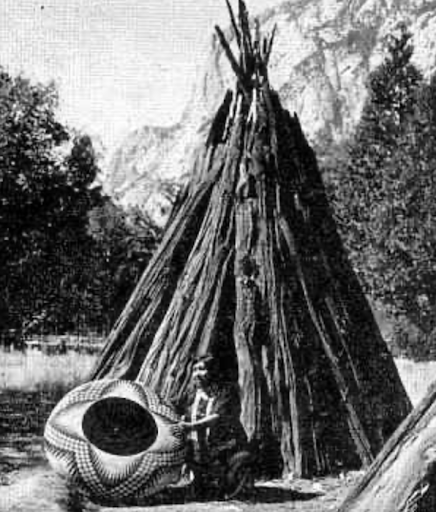
During the summer, the semi-nomadic California Maidu tribe lived in temporary pointed, conical cedar bark shelters, constructed from several poles tied together, covered with bark and sticks over the framework.
During the summer, the semi-nomadic California Maidu tribe lived in temporary pointed, conical cedar bark shelters, constructed from several poles tied together, covered with bark and sticks over the framework.
The more permanent winter homes of the Maidu consisted of villages of semi-subterranean structures built up to 15 feet into the ground. The Californian pit house was constructed of earth and brush sidewalls, wood end walls, and a pitched roof that was completely covered in earth. The Maidu winter houses had a central fire pit. An opening in the roof allowed the smoke to escape and also let light and air in. Entrance was accessed via a ladder on the roof.
If you find yourself in Quincy, California, visit the Plumas County Museum at 500 Jackson Street.